söndag 11 oktober 2015

Nils Jonasson och Rotary (1956-1989). En son botaniserar i sin fars Rotaryminnen.


(Föredrag av Ulf Jonasson på Frösö Rotaryklubb 8 oktober 2015)

Under några dagar har jag varit på besök i mina gamla hemtrakter, dvs Frösön och Östersund. Mitt egentliga ärende var att hålla ett föredrag på Frösö/Wargentins Rotaryklubb som handlade om min pappa.

Han var med om att starta Frösö-föreningen 1956 och han var Rotarian till sin död 1989. För cirka ett år sedan hittade jag ett kuvert – som legat längts ner i en låda – och detta kuvert innehöll bl a fem föredrag som Pappa hade hållit under sina är i klubben. Detta var mycket intressant för mig och av de glömda materialet arbetade jag fram ett föredrag om Pappas tid och engagemang i Frösö-Rotaryklubb.

Första gången jag höll mitt föredrag var i min egen klubb här i Katrineholm. Nu var jag alltså uppbjuden till Frösöklubben för att dela med mig till den Jämtländska gruppen, varav flera kände Pappa. mycket väl, en del också från andra sammanslutningar.

Efterlämnade Rotary-dokument från åren 1956-1968

1.       Ego föredrag från 1957
2.       Minnen från en USA-resa 1961-62
3.       Besök i sju klubbar i USA
4.       En tavlas historia – Forest Lawn, Ca
5.       Är det något som kännetecknar en Rotarian?

Det var en stark känsla att få dela med mig av Pappas funderingar, det är ju nästan 60 år sedan han skrev sitt Ego-föredrag. Som framgår av namnet så presenterar alla medlemmarna ett föredrag om sig själva – vilket brukar vara de föredrag som uppskattas mest.

Frösö-klubben fyller 60 nästa år, det stora firandet sker i mitten av maj. Klubben har redan arbetet flera månader med förberedelserna.

Dagen till ära hade jag själv inbjudit några nära och kära att vara med vid lunchen, två av mina äldsta och bästa vänner – som jag dessutom bodde granne med under många år - Göran Jonsson och Bosse Nilsson - båda gamla Rotarianer, min svåger Bo-Göran Karlsson samt min systerson, Lasse Collin. 

På mötet var också mitt gamla kompanibefäl när jag gjorde lumpen på I 5 i Östersund Ambjörn Sandler, vars två bröder – Håkan och Staffan - jag samarbetat en hel del under mina många år i Uppsala. Mötet med Ambjörn kändes också mycket positivt.

Det är en något ovanlig uppgift att hålla ett föredrag om sin egen Pappa, men det har berett mig mycket stor glädje att få göra det, och dessutom i en miljö som han själv tyckte mycket om och tillhörde i mer än 30 år. Att sedan känna av gruppen glädje och värme när jag berättade om en av de som startade föreningen för 60 år sedan kändes mycket gott.

Bildtexter:  

Klubben ordförande heter Elisabeth Viggeborn och den programansvariges namn är Bertil Olsson, som jag haft kontakt med tidigare när jag föreläste om vår forskning. Här ses vi på en s k selfie. På övriga bilder ser vi Pappa Nils, som han såg under när han klubben bilades 1956, själv figurerar jag också på en bild, tillsammans med Göran och Bosse. 

tisdag 6 oktober 2015

Hans Rosling den stora stjärnan på Publicistklubbens möte 5 okt.


För några veckor sedan besökte jag en föreläsning med den världskände fysikern Stephen Hawking som besökte Stockholm. Det var den mest fascinerande föreläsningen jag upplevt på 50 år inom universitetsvärlden. I början av september var det alltså 50 år sedan jag skrevs in vid Uppsala universitet.

Nu har alltså nästa 50-års period inletts, och med en föreläsning som endast var snäppet under Hawkings. Med detta vill jag säga att jag på måndagskvällen besökte Publicistklubben i Stockholm och den stora stjärnan där var professorn i global hälsa Hans Rosling. Det är andra gången jag ser och hör honom live och det är en upplevelse av stora mått. Visst är det spännande att se honom på TV, men knappast inget slår honom uppträda live.

PK bjuder också på en debatt vid sina möte och den här gången var det Gunilla Jarlbro, professor i medie- och kommunikationsvetenskap, Institutionen för kommunikation och medier, Lunds universitet och Ulf Johansson, programchef riksnyheter på SVT som medverkade samt PK´s ordförande Björn Höger. Han avslutade debatten med att komma med en fråga från sin mamma, som tyckte att Rosling verkade lite sliten efter sitt intensiva arbetsschema. Roslings svar ser Du här http://bit.ly/1RrUD66

Man kan klart säga att den här kvällen blev Roslings, de andra två i panelen blev mera stafflagefigurer. Det är med andra ord inte lätt att konkurrera med Rosling, som numera är en världsstjärna – rent av.

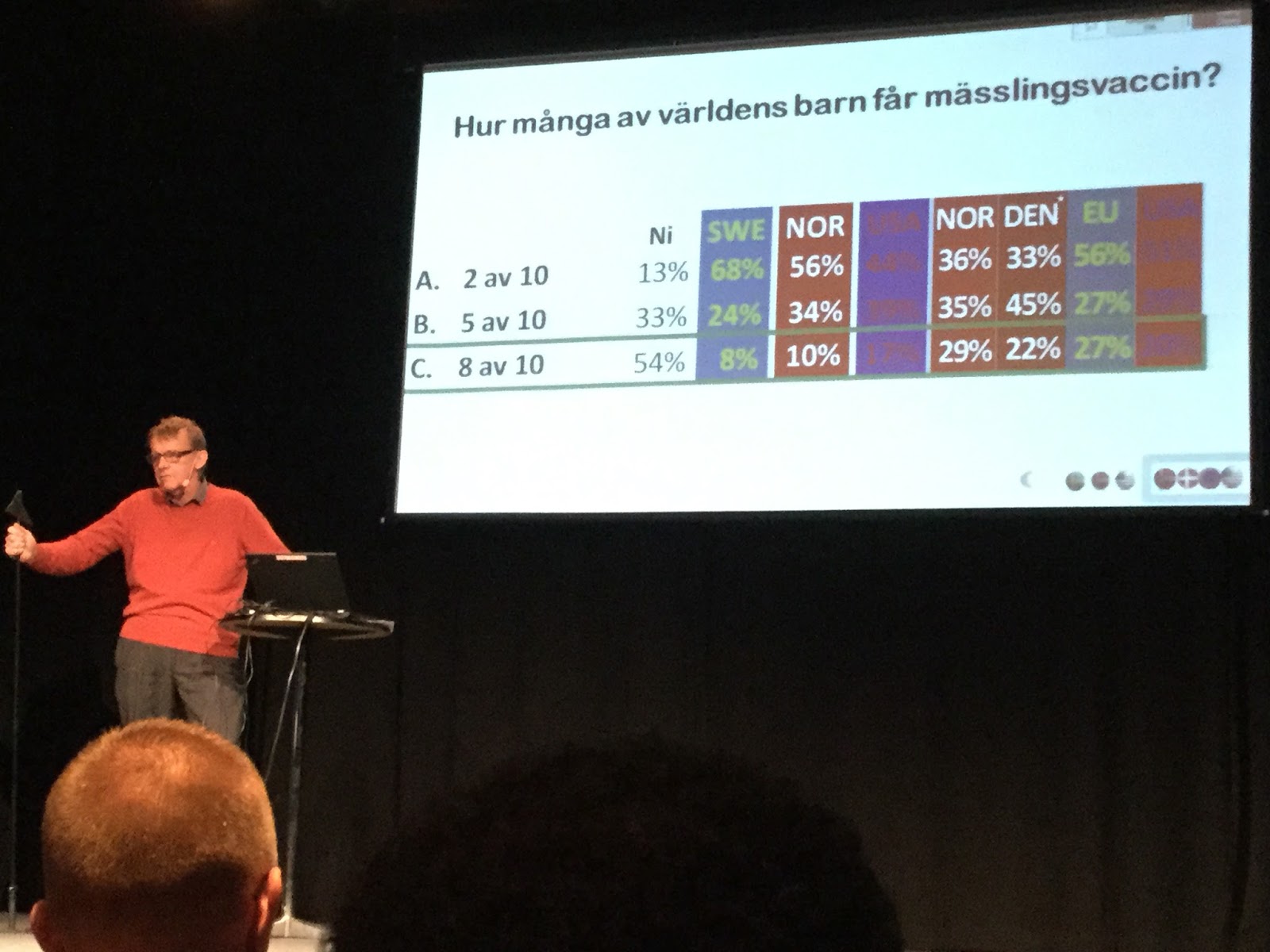
Sin vana trogen ställer han ett antal frågor till publiken och vi får en mentometerknapp  (som bl a användes när ungdomar skulle röst i Tio i topp för snart hundra år sedan – eller vad det heter, våra klick kan alltså. Det är en ren kunskapskontroll. Som framgår av mina bilder så var en fråga; Hur många av världens barn får mässling-vaccin?

De närvarande Journalisterna igår visade sig var de som svarat allra bäst, dvs gett flest rätta svar som Rosling någonsin har fått under sina år av föreläsande om detta. Nu har ju vi varit lite smarta och läst på, skam vore annars.

Referat från gårdagens höjdarmöte får en aktiv kollega – den här gången från Expressen - svara för. Det bär mig emot lite grann att referera till nån av kvällstidningarna, men det får vara för den här gången. http://bit.ly/1GtS90x

På den här länken har du både Roslings föreläsning och den efterföljande debatten http://bit.ly/1OUPuVE

Sammantaget: En fantastisk kväll med en stor personlighet som ville ge journalisterna mera kunskap, så att de därmed kan upplysa den s k allmänheten


torsdag 17 september 2015

At Eli Lilly's website mentioned the two big sellers - Darvon & Darvocet - just on two occasions, to hide the pills fatal history


For some years ago, when there “were no problems at all “with Propoxyphene – Darvon, Darvocet – you could read a lot on Eli Lillys homepage about propoxyphene.  Today when you search “Eli Lilly propoxyphene” on Google , you get 23 000 hits, if you Google “Lilly Darvocet” you get 46 000 hits. 

But when you search for Propoxyphene on the homepage of Eli Lilly today you get 2 (two) hits, both referring to the Annual report, 2011 and 2012. http://bit.ly/1MaUguI

There you could read following

2011 – Eli Lilly Annual Report, and presented 2012 for the shareholders

“Along with several other manufacturers, we have been named as a defendant in approximately 165 cases in the U.S. involving approximately 755 claimants related to the analgesic Darvon and related formulations of Propoxyphene”.

2012 – Eli Lilly Annual Report, and presented 2013 for the shareholders

“Along with several other manufacturers, we have been named as a defendant in approximately 125 cases in the U.S. involving approximately 1,890 claimants related to the analgesic Darvon and related formulations of  propoxyphene”

The Annual Reports for 2013 and 2014 do not have a single word about Propoxyphene or Darvon, Darvocet. 

The shareholders have reason to be worried about the coming trails, we assure you it will be big problems for Eli Lilly and other involved companies.

It is about five years ago since Propoxyphene was banned in US (Nov 19th 2010) and the lawyers and judges have been discussing since then.

These Lawyers and judges have had complex legal discussions over these past five years. Apparently they cared not at all about the thousands of causes people affected, heart problems or who often have people become fatally poisoned.

Some others big trials where Eli Lilly also 

The news-agency AP reported April 8, 2014:

Jury hits Takeda, Eli Lilly with $9-billion penalty

- U.S. jury ordered Japanese drugmaker Takeda Pharmaceutical Co. and its U.S. counterpart, Eli Lilly and Co, to pay $9 billion in punitive damages over a diabetes medicine linked to cancer. The drug companies said Tuesday they will "vigorously challenge" the decision.

- The U.S District Court in western Louisiana ordered a $6 billion penalty for Takeda and $3 billion for its business partner and co-defendant Eli Lilly. It also ordered $1.5 million in compensatory damages in favor of the plaintiff.

This process took some three years from beginning to end. The processes of Propoxyphene involving thousands of people thus have not even begun. 

The question is when these trials can begin.

lördag 12 september 2015

Unique Swedish data influenced the banning of Dextro-Propoxyphene in the world


PREFACE to the report " Restrictions on the prescribing of DextroPropoxyphene (DXP) – effects on sales and cases of fatal poisoning" http://bit.ly/1O6QwOa 

Regarding the analgesics compound (Dextro) Propoxyphene since 1991, when the four branches of forensic science in Sweden (medicine, psychiatry, chemistry and genetics) were organized into one authority, the National Board of Forensic Medicine, an extensive database has been set up for forensic medical and toxicological information. 

Consequently, we have unique opportunities in Sweden to follow developments within these fields at a comprehensive national level. 

Forensic research based on our four registers has demonstrated that 1 592 persons (200 persons a year) in Sweden were fatally poisoned by the analgesic compound (Dextro) Propoxyphene (DXP) between 1992 and 1999. The problems with DXP poisonings were already noted during 1970´s. 

The Swedish research on DXP – which has attracted a great deal of attention in the media as well as in political circles – has contributed to the decision made by the Swedish Medical Product Agency to issue special restrictions effective from June 15, 2001. This means that DXP agents today have to be prescribed on a specific form, which in practice signifies a narcotic classification. In Denmark and Norway, however, restrictions similar to those introduced in Sweden 2001 have been force since the 1980´s. 

In April 2003 a Swedish member of the European Parliament, Dr Marit Paulsen, raised a question in the Parliament concerning the risk of DXP poisoning. She asked if the Commission was aware of the problems with DXP in Sweden and pointed out that the DXP problems are probably worse in two other EU countries namely the United Kingdom and France. The question is at present prepared by EMEA – The Medical Products Agency of the European Union – and one of their subcommittees. 

This present study – Restrictions on the prescribing of dextropropoxyphene(DXP) – effects on sales and cases of fatal poisoning – is written by Ulf Jonasson, Doctor of Public Health and Birgitta Jonasson, PhD, on behalf of The National Board of Forensic Medicine and The Medical Products Agency in cooperation with The National Board of Social Insurance Board and The Swedish Poisons Information Centre. 

Ulf Westerberg 

Director General National Board of Forensic Medicine 

Restrictions on the prescribing of Dextro-Propoxyphene (DXP) – effects on sales and cases of fatal poisoning


SUMMARY: 

In 2001 the Medical Products Agency implemented restrictions in Sweden on the prescribing of the analgesic agent Dextropro-Poxyphene (DXP). This was done in the light of findings by researchers in forensic medicine showing that 200 individuals per year had died as a result of intoxications in which DXP was assessed to have caused or contributed to the fatal outcome. The restrictions state that drugs containing DXP must be prescribed on a special prescription form. 

The principal aim of the present study was to evaluate the effects of the restrictions with regard to sales of DXP products, number of cases with DXP found in the blood at forensic medicine examinations and the number of intoxications where DXP was considered to have caused or contributed to the fatal outcome. In order to compare the time before and after the restrictions, the study was extended over the years 2000 to 2002. The basic studied years were 1992-1999.

To elucidate further the development after the introduction of restrictions, data from the first quarter of 2003 were collected where possible. In order to explore certain aspects in greater depth, comparisons were also made with data from the 1990s. Data on sales of DXP products in the studied period were obtained from Apoteket AB and the Medical Products Agency. 

To study the occurrence of DXP in forensic material and the number of intoxications in which DXP was assessed to have caused or contributed to the fatal outcome, data were collected from two national data bases linked to forensic medicine and forensic chemistry in Sweden. The study showed that sales decreased gradually during the studied period. Compared with the first quarter of 1999 sales in the first quarter of 2003 sales were 66 per cent lower. The decrease in sales had already begun before the restrictions were introduced, which probably can be explained by the great publicity that the forensic study results were given in the media between 1998 and 2001. 

The decrease continued, however, and between the first quarter of 2001 and the first quarter of 2003 the sales decreased by 50 per cent. The continuous decline was most probably due to the restrictions. 

The study also showed that the number of cases with DXP in the blood decreased continuously during the whole time period, as also did the number of DXP intoxications. From the first quarter of 2000 to the first quarter of 2003 the number of cases with DXP in the blood decreased by 57 per cent, from 95 to 41. 

The number of fatal DXP poisonings decreased from 53 per quarter to 20 during the same period, i.e. 62 per cent. (The total number of fatal poisoning cases in 2000 was 198, in 2001 it was 152 and in 2002 it was 122. The estimated number in 2003, based on forensic statistics of the prevalence of cases with DXP in the blood, was 70). Just as was the case with sales, the decrease in number of cases with DXP in the blood and in the number of DXP intoxications started already before the restrictions and then there was an obvious fall during the last quarter of 2001. 

The number of fatal poisoning cases has been halved since the restrictions were introduced (from 45 to 20). The reduction of the number of fatal poisonings is favourable, but as long as the drug is still on the market there will be new cases of intoxication. As DXP today is known to be especially dangerous, particularly in combination with alcohol, suicidal individuals will continue to choose this drug in the future. The problem of the impulsive suicidal acts, those that are not intended to be fatal, will remain. 

The study results also show that the proportion of addicts is high among those who have DXP in their blood when they die. These still constitute a considerable risk group for continued DXP intoxications, both involuntary and those self-inflicted on impulse. Thus, further restrictions in prescribing or total withdrawal of the DXP products would have to be considered to completely solve the problem of fatality due to DXP. 

onsdag 9 september 2015

Om bara Telia hade orkat ta reda på var jag bor hade vi inte haft något problem


"Lösenord skickas till den adress du är folkbokförd på. Uppdatera gärna dina uppgifter när Du mottagit detta så är det enklare framöver//NJ"
      
å    Så svarar en kontaktperson på TeliaSverige efter mitt förra meddelande.

     Jag tycker att detta är väldigt arrogant skrivet, en person som blir djupt kränkt när jag påpekar att TeliaSverige har gjort fel – och det inte bara en gång.

     Hela denna fråga hade varit löst för 10-12 dagar sedan om Telia bemödat sig om att ta reda på var vi bor samt vilken mail-adress vi har. Ett tips, kolla på räkningen och vilket mail-abonnemang vi har, då hade frågan inte varit något problem

     Betyget för TeliaSveriges agerande sjunker ännu mer.

     PS.
    
     Trots att min fråga upprepats om vart lösenorden har sänts INTE besvarats. Anser Telia att vi bor i Björkvik så skall det vara så - enligt Telia.


På en skala från +1 till +5 får Telia -3 för hur dom handlagt mitt ärende. Bra jobbat Telia


En och annan av mina FB-vänner, men ännu fler av mina Twitterföljare och blogg-läsare, torde har märkt att jag varit tämligen frustrerad och irriterad under några dagar. Anledningen är att jag har bemötts av det mest stelbenta agerande jag tror att jag varit utsatt för – någonsin. Man tror inte att sådant är ens möjligt.

Jag har använt flera timmar med Telia, telefonledes (suttit i flera telefonköer – totalt några timmar) kontakt via Direkt Message på Twitter, via Twitter och genom en viss länk där mitt ärende behandlas. Jag har haft kontakt med sju-åtta personer på skilda nivåer – och totalt har dom använt en del arbetstid. En del fick jag veta namnet på, Mikael, Ellinor, KL, NJ och FA – plus några anonyma telefonröster.

Vad är det då frågan gäller.

Jag har kontaktat Telia för att få ett nytt lösenord till Mina Sidor på Telia. Thats all. Anledningen till detta är att min dator pajade för några veckor sedan när jag skulle ladda upp Windows 10, det slarvet har jag tagit på mig. Problemet är att när Telia sänder detta lösenord sänder dom till MIN förra adress – som vi flyttade ifrån för två år sedan. För att informera mig sänder dom till mitt sedan flera år avslutade hot-mail konto.

Genom sitt felagerande ställde Telia till att jag fick kontakt med Kronofogden, vilket jag aldrig haft på mina hittills 73 år. Då bad en person faktiskt lite grann om ursäkt.

Telia säger att jag skall ändra min hot-mailadress, men det måste göras på Mina Sidor på Telia och det är dit jag vill ha mitt nya lösenord. Snacka om Moment 22.

Alldeles nyss – efter att ha varit i klagobranschen i 10 – 12 dagar - fick jag ett svar från en person som säger att dom sänt till mig mitt nya lösenord, jag får det med posten NÄSTA VECKA.

På min fråga till vilken adress dom sänt detta NYA brev – till min gamla adress eller till min nuvarande adress - har jag inte fått något svar. Sannolikt kommer svara att bli – om jag ens får något svar – lösenordet har sänts till din mantalsskrivningsadress – om det är den gamla eller min nuvarande. Telia och jag har alltså olika uppgifter om var jag, hustrun och Vovven bor på.


Vem litar Du på?, Telia eller mig?